
Overthinking can leave you mentally exhausted, anxious and unable to make simple decisions. To stop overthinking, begin by recognising repetitive thoughts, separating facts from assumptions and taking one manageable action. Grounding exercises, scheduled worry time and professional support may also help you feel more in control.
Thinking carefully about an important decision is normal. However, when the same thoughts continue without producing an answer, productive thinking can become an unhelpful cycle.
This guide explains how to stop overthinking using practical techniques you can apply in everyday life.
Overthinking means repeatedly analysing a situation, decision or experience without reaching a helpful conclusion.
It usually appears in two ways:
Productive thinking usually leads to an action or decision. Overthinking often leaves you stuck in the same place.
| Productive thinking | Overthinking |
|---|---|
| Focuses on finding a solution | Repeats the same problem |
| Uses facts and available information | Relies heavily on assumptions |
| Leads to a decision or action | Creates indecision and avoidance |
| Has a stopping point | Continues without resolution |
| Helps you feel prepared | Often makes you more anxious |
Ask yourself: “Is this thought helping me decide what to do next?”
If the answer is no, you may have moved from thinking into overthinking.
Common signs of overthinking include:
Some people also experience physical symptoms associated with stress or anxiety, such as muscle tension, disturbed sleep, stomach discomfort or a racing heartbeat.
However, unexplained physical symptoms should not automatically be blamed on anxiety. Speak to your GP if symptoms are persistent, severe or causing concern.
There is rarely one single cause of overthinking. It may develop from a combination of stress, personality, past experiences and learned behaviour.
Common triggers include:
Overthinking can feel protective. Your mind may believe that considering every possible outcome will prevent mistakes or disappointment.
In reality, searching for complete certainty often creates more questions and makes it harder to act.
You may not be able to prevent every unwanted thought. Instead, the aim is to recognise when your mind is caught in a loop and choose a more helpful response.
The first step is recognising what is happening.
When you notice a repetitive thought, describe it without judging yourself:
“I’m replaying that conversation because I’m worried I embarrassed myself.”
This creates distance between you and the thought. Rather than treating it as a fact, you begin to recognise it as a mental event.
Try changing:
“I have ruined everything.”
To:
“I’m having the thought that I have ruined everything.”
This small change can make the thought feel less absolute.
Overthinking often fills missing information with the worst possible explanation.
For example, if someone has not replied to your message, you might assume they are upset. The only fact is that they have not replied yet. Everything else is an interpretation.
Divide a page into two sections:
What I know:
What I am assuming:
Seeing the difference can help you respond to the information you have rather than the outcome you fear.
Trying to force a worry away can sometimes make it return more strongly. Instead, set aside 10–15 minutes to consider your concerns.
If a worry appears outside that period, write it down and return to it later.
During your scheduled worry time, ask:
The NHS also recommends setting aside “worry time” to help prevent worries from taking over the rest of your day.
When a situation feels overwhelming, ask yourself:
This technique is not about ignoring genuine problems. Instead, it helps you judge how much attention a situation deserves.
If it will still matter in five years, focus on the next sensible action rather than trying to solve the entire problem at once.
Overthinking can lead to analysis paralysis. This happens when you spend so much time examining the options that you take no action.
Choose the smallest useful step available.
If you are overthinking a job application, update one section. If you are worried about a conversation, write down the main point you need to communicate.
Taking action provides new information and can restore a sense of control.
The NHS “catch it, check it, change it” technique encourages you to notice an unhelpful thought, examine the evidence and find a more balanced perspective.
Ask yourself:
You do not need to replace every negative thought with an overly positive one. A neutral statement may feel more believable.
Instead of:
“My presentation will be a disaster.”
Try:
“I may feel nervous, but I have prepared and can take it one section at a time.”
Overthinking usually pulls your attention into the past or future. Grounding exercises return your focus to the present.
Try the 5-4-3-2-1 exercise:
Take your time. The purpose is to move your attention away from the thought loop and towards your surroundings.
Stress can make your breathing quicker and shallower. In turn, this can make a situation feel more threatening.
Try the following:
Do not force your breathing or continue if you feel uncomfortable. The aim is simply to slow down before returning to the problem.
Overthinking may feel worse when you are tired, overstimulated or already under pressure.
Helpful changes may include:
These changes may not address the underlying cause. However, they can make your thoughts easier to manage.
Many decisions do not come with a guarantee.
You can gather information, consider the likely outcomes and make the best decision available. Thinking beyond that point does not always produce a better answer.
Set a reasonable deadline for smaller decisions. Once you have chosen, avoid reopening the decision unless new information becomes available.
Learning to tolerate uncertainty can play an important role in breaking the cycle of overthinking.
Overthinking can become more noticeable at night because there are fewer distractions.
Write down tomorrow’s tasks before bed, schedule worry time earlier in the evening and avoid checking work messages once you are in bed. Slow breathing or a grounding exercise may also help you return your attention to the present.
Try not to treat sleep as another problem you must solve perfectly. Becoming frustrated about being awake can create another layer of worry.
Occasional overthinking is common. However, consider speaking to your GP or a qualified mental health professional if repetitive thoughts:
If you feel unable to keep yourself safe, call 999 in an emergency, contact NHS 111 or call Samaritans free on 116 123.
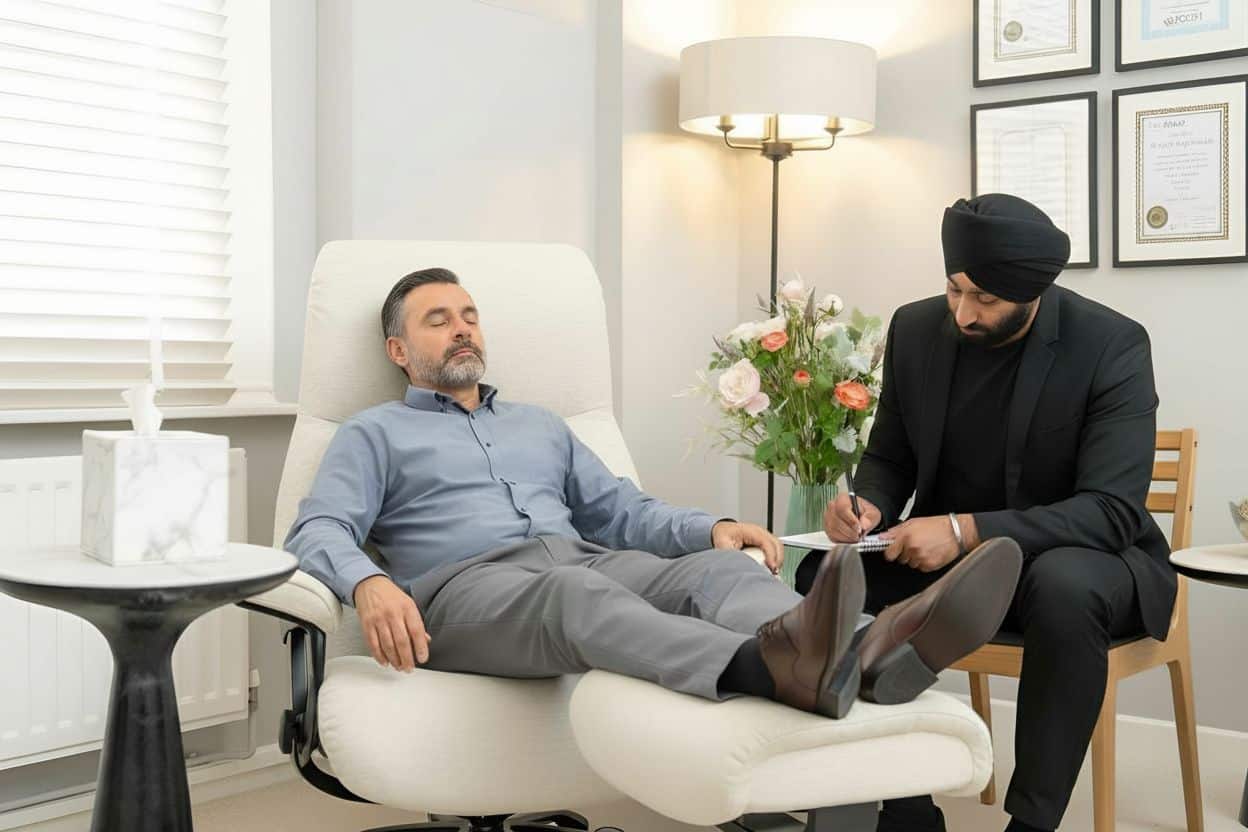
Hypnotherapy uses focused attention and guided relaxation to explore thoughts, beliefs and behavioural patterns.
Some people use hypnotherapy alongside other forms of support to improve relaxation, build confidence and develop a different response to emotional triggers. Sessions may explore what is driving the pattern, such as fear of failure, stress, low confidence or a difficult experience.
At Platinum Mind Therapy, every session is tailored to the individual rather than following a generic script. Hypnotherapy is not a guaranteed cure and may not be suitable for everyone. An initial consultation provides an opportunity to discuss your concerns and whether this approach may be appropriate.
Overthinking is not a diagnosis, but repeated worry and rumination can occur alongside anxiety. It can also happen during periods of stress, uncertainty or low confidence.
Your mind may be trying to prevent mistakes, rejection or uncertainty. Perfectionism, stress, difficult experiences and low confidence may also contribute.
The 5-5-5 rule involves asking whether the issue will matter in five minutes, five days or five years. It can help you place a worry in perspective.
Write down your worries before bed, prepare a short list for the following day and follow a calming routine. Slow breathing and grounding exercises may also help.
Hypnotherapy may help some people recognise unhelpful patterns and respond differently to triggers. Results vary, and it should not be presented as a guaranteed way to stop overthinking.
Learning how to stop overthinking does not mean eliminating every difficult thought. It means recognising when your thoughts are no longer helping and choosing a more constructive response.
Start with one technique and practise it consistently. If overthinking is affecting your sleep, confidence, relationships or ability to make decisions, professional support may help you understand what is keeping the cycle going.
Platinum Mind Therapy provides personalised hypnotherapy and mind-based therapy in Leamington Spa, Birmingham and online. Book a complimentary consultation to discuss your concerns and the support available.